Highlander Clan
SCOTTISH ROMANCE: My Sinful Surrender to a Highlander Werewolf (Scottish Werewolf Pregnancy Romance) (Historical Medieval Shape Shifter Paranormal Science Fiction Short Stories)Highlander Clan is a werewolf mercenary organization whose survival is threatened by Sven’s imperial ambitions and whose intervention turns a campaign of conquest into a struggle over resistance, secrecy, and political leverage. Led in the relevant opening episodes by Carden, the clan is both a fighting force hired by the Kingdom of Kigom and a community with economic ties and personal loyalties among nearby human villagers.
Nature and Political Position
Highlander Clan operates as a professional warrior group willing to undertake missions that ordinary armies cannot complete. The King of Kigom hires Carden and his clan because Kigom’s forces cannot defeat Sven’s army, while the Highlanders are prepared to work as mercenaries and pursue the assignment at any cost. Their objective is not to enlarge Sven’s kingdom or claim Kigom for themselves; they accept the mission because Sven’s conquest threatens both the political balance of the region and the clan’s continued existence.
The clan’s hostility toward Sven is therefore defensive as well as strategic. Sven regards the Highlanders as filthy animals and wants them removed from his cities, prevented from breeding with his people, and ultimately eradicated. The Highlanders understand that he is not merely another invading king. He has studied them for years, has collected reports from soldiers who shot them without stopping them, and has come closer than earlier rulers to discovering their secrets. Carden knows that if Sven learned the Highlanders could be killed only by decapitation, Sven would attempt to destroy every member of the clan.
Community, Resources, and Human Ties
Although Highlander Clan is a military organization, it is not portrayed as detached from ordinary society. The village attacked by Sven’s army is one of the few places where the clan feels accepted. The Highlanders sell the fur from their kills there, obtain meat, and use the proceeds to equip the entire clan with the best weapons available. Their relationship with the villagers is also personal: the clan has grown fond of the people, making the burning of the settlement an assault on a community rather than merely the loss of a supply point.
Sven deliberately chooses the village because he knows the Highlanders frequent it. By burning its cottages, taking whatever remains, and leaving smoke and ruins behind, his army sends a message that it knows where the clan operates and intends to pursue it. The attack also exposes the practical dependence linking the Highlanders and the human population. The destruction of the village threatens weapons, food, trade, and shelter at once, while the clan’s attachment to the inhabitants gives Sven a way to injure Highlander morale.
Carden’s response reveals the clan’s protective obligations. He searches the ruined village with the other Highlanders, checks for surviving soldiers, and makes sure the area is safe before survivors are removed. In a partly burned cottage, he finds a dead woman and covers her naked body with a blanket, attempting to restore some dignity after the violence inflicted by Sven’s troops. The gesture contrasts with the army’s treatment of civilians and shows that the clan’s violence is framed by a code of responsibility toward those under its protection.
Military Action and the Zuzulla Mission
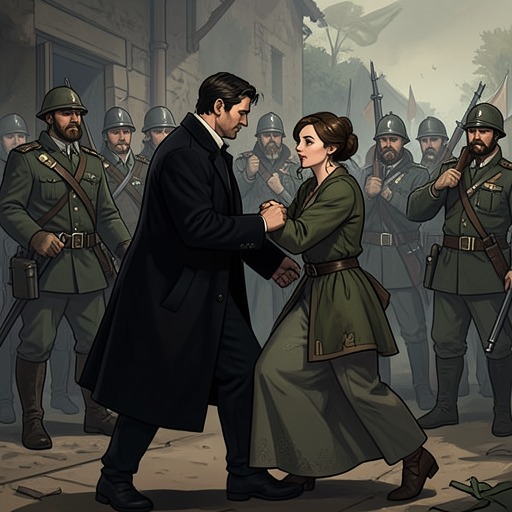
The Kigom mission centers on Zuzulla, Sven’s daughter. Kigom’s king knows that Sven values her more than anything else and reasons that her disappearance could redirect Sven’s attention from conquest to rescue. The abduction is consequently designed as political pressure: the Highlanders are to take the king’s daughter so that Sven’s campaign will become a search for his child instead of an uninterrupted expansion into Kigom.
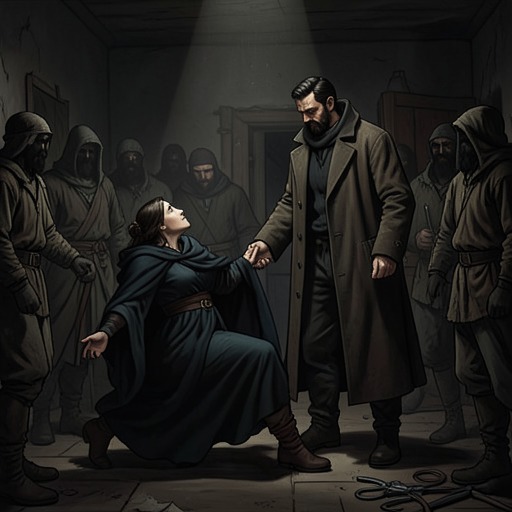
The assignment places Highlander Clan inside a morally complicated resistance strategy. The group is fighting a ruler who burns villages and seeks its extermination, yet its chosen leverage is the seizure of a young woman whose father’s crimes are not hers. Carden finds Zuzulla while she is walking alone in the forest after evading the guards assigned to protect her. He covers her mouth, renders her helpless, carries her through the woods, and brings her to a waiting horse before the palace guards can discover what has happened.
Carden’s escape is organized around speed and concealment. He believes he has roughly an hour before the guards begin searching and runs with Zuzulla over his shoulder toward the far side of the forest. Her dress obstructs him, so he tears away the excess fabric and leaves it in the dirt, knowing that the damaged clothing will intensify Sven’s panic when it is found. Within about thirty minutes he reaches the horse, mounts, and positions Zuzulla facing him with her legs around his waist and her head against his chest. His momentary guilt makes clear that the mission’s strategic logic does not erase the human cost of carrying it out.
Internal Ethics and Survival Rules
The clan’s secrecy is central to its security. Its members are not simply unusually strong soldiers; they are shapeshifters whose abilities have been concealed from hostile rulers and armies. Sven’s long fascination with their reported resilience makes knowledge itself a weapon. The Highlanders must protect not only their bodies but also the information that explains how those bodies can be killed.
Their treatment of the young survivor from the village further demonstrates the tension between communal protection and individual choice. Carden recognizes a girl no older than sixteen hiding behind a table, and she clings to him while sobbing. He expects that she will be taken back to the clan and changed into a werewolf, believing the clan’s elders will approve. Yet he also wonders whether she understands what that future means and whether survival within the clan might be worse than death at the hands of Sven’s army. The episode presents membership as both rescue and irreversible transformation, making the clan’s protection inseparable from its power to redefine a survivor’s body and future.
Bloodline, Rank, and Contrast with Other Werewolf Orders
Highlander Clan’s military identity forms a sharp contrast with the pure-blood hierarchy represented by Accalia and Tate’s pack. Tate recognizes that werewolves may descend through an unbroken line of werewolf ancestors, may be born from a werewolf and a human, or may be changed by another werewolf. Accalia treats ancient pure lineage as proof of superiority and humiliates mixed or changed werewolves, whereas Tate argues that a werewolf remains a werewolf regardless of ancestry. Against that background, Highlander Clan is defined less by aristocratic pedigree than by collective strength, mercenary discipline, secrecy, and resistance to persecution.
The comparison also clarifies why bloodline politics recur across the wider narrative. Pure ancestry is used elsewhere to regulate royal succession, marriage, and access to power, but Highlander Clan’s immediate crisis comes from an external ruler who wants to prevent its reproduction altogether. Its existence challenges the assumption that political legitimacy belongs only to royal or pure-born bodies. The clan’s survival, and its willingness to change a human survivor, show how lineage can function simultaneously as identity, defense, and a contested form of control.